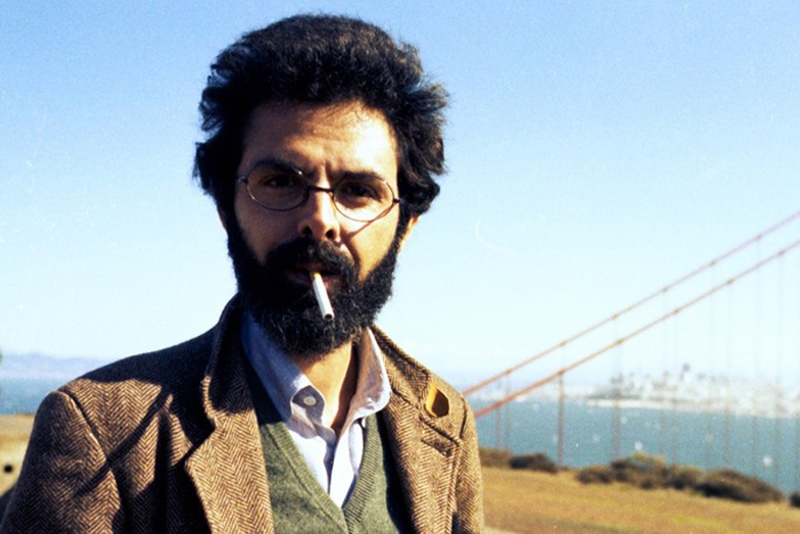
Interview with Behrang Samsami about Sohrab Shahid Saless
The following interview was held over e-mail in May of 2026 with Behrang Samsami, a scholar and freelance journalist who was born in Iran and is currently based in Germany. Samsami is a Ph.D. graduate of German Studies who has programmed Sohrab Shahid Saless’s cinema on multiple occasions (for example, at the Munich Film Festival in 2024 ) and written extensively about it, most notably with his three-volume-long biography of the filmmaker, The Long Vacation of Sohrab Shahid Saless ( Die langen Ferien des Sohrab Shahid Saless, 2023 ). Although the book currently exists only in German, an article in English by the author that summarizes much of its content was recently published in the online journal Transit, which is sponsored by the Department of German at the University of California, Berkeley. Thanks go to Samsami not only for the following interview, but also for answering questions and providing relevant reading materials throughout the research process involved in preparing the screenings at the Instituto Moreira Salles of Shahid Saless’s film Far from Home (Dar Ghorbat / In der Fremde, 1975).
Mutual Films: We understand that Sohrab Shahid Saless was the son of a civil servant and that he lived in different places in Iran when he was young as a result. What do you believe were the major factors that led him to want to make cinema, and to work with cinema in particular, rather than with any art form (for example, literature) or field of work?
Behrang Samsami: Sohrab Shahid Saless, born in 1944 in Tehran, came from a middle-class family. He does not seem to have had a happy childhood or adolescence. His biological mother left the family when he was one and a half years old. He therefore grew up with his aunts and a stepmother. This loss, combined with a difficult family life, had a lasting impact on him. Judging by statements from Saless, relatives and friends, the cinema seems to have become for him a place of escape, of dreams, but also of possibilities.
One must also consider the socio-political circumstances: following the CIA-backed coup against Prime Minister Mohammad Mossadegh in 1953, Iran became a dictatorship under Shah Mohammad Reza Pahlavi. Back then, young Iranians began to go abroad, study film or other subjects and learn for example about Italian neorealism and the French Nouvelle Vague. When these young Iranians returned home, they sought to counter the apolitical entertainment cinema known as Filmfarsi, as well as imports – particularly from the US and India – with a realistic, socially critical cinema. This movement, which included filmmakers such as Dariush Mehrjui, Masoud Kimiai and Bahram Beyzai, later became known as the Iranian “New Wave”.
Sohrab Shahid Saless, for his part, was a sensitive, vulnerable man and a keen observer of his surroundings. After finishing school in 1962, he wanted to study film at IDHEC in Paris. When that proved impossible, he moved to Vienna. Others who went on to make feature films and documentaries in Iran, such as Khosrow Sinai and Manuchehr Tayyab, also studied here. In Saless’s case, there is the added factor that his biological mother lived in Vienna with her second family. Filmmaking therefore allowed Saless to combine two things that were important to him: to engage artistically with his own traumatic experiences, whilst at the same time remaining committed to reality and creating universal and singular ‘Bild-Landschaften‘, a German term that could be translated as ‘photographic landscapes’.
If one reads the screenplays he wrote in German for his films, it is clear that Saless would also have made a very good writer. His decision to make films was influenced by cinematic role models like Robert Bresson, Yasujiro Ozu and Forough Farrokhzad, but also by writers like Franz Kafka and Albert Camus and particularly by one Russian author: Anton Chekhov.
MF: We are also aware that Shahid Saless valued Anton Chekhov’s writing very deeply, and that Chekhov appears as a reference or even point of departure throughout multiple films. There is his biographical film made for German television, Anton P. Chekhov – A Life (Anton P. Cechov – Ein Leben, 1981), as well as his filmic adaptation of a Chekhov story, The Willow Tree (Der Weidenbaum, 1984), as well as many other instances of Chekhov appearing. For example, the film Time of Maturity (Reifezeit, 1976) is dedicated to Chekhov; the fate of the protagonist Mohammad in Still Life (Tabi’at-e bijan, 1974) recalls that of the elderly servant Firs in Chekhov’s play The Cherry Orchard (Vishnyovyi sad, 1904), with both men cast aside by the modern world; and the homage to a Chekhov story from 1885 (whose English-language title is in “In a Foreign Land” in English) that is embedded in the original German-language title of the film Far from Home. What do you believe were the chief factors that drew the filmmaker most immediately and specifically to Chekhov's writing, and what do you believe were the most crucial qualities of Chekhov’s work that he wanted to bring to the cinema in general and to his own filmmaking in particular?
BS: Sohrab Shahid Saless has described Anton Chekhov as a “maestro”. For the filmmaker, the Russian writer’s mastery lay, among other things, in his ability to create works that, when read, struck him as though they had been written only recently. It is quite possible that, whilst reading Chekhov’s short stories and plays, which are set in Russia in the late 19th and early 20th centuries, Saless was reminded of his own homeland and era: The wealth of the Tsar, the nobility and the entrepreneurs, and the poverty of the vast majority in the multi-ethnic Russian Empire; the autocratic and centralised nature of the state and its backward economic structure; the contrasts between the capital and the provinces; and a life caught between modernity and tradition – the conditions described by Chekhov bear striking parallels to Iran under Shah Mohammad Reza Pahlavi. Saless seems to have recognised these parallels as well.
“What interests me greatly is Chekhov’s style of writing. I try very hard to film in the same way that he wrote,” said Saless in 1974 in an interview with Ulrich Gregor, a German film journalist and one of the founders of the International Forum of Young Film in West Berlin. Chekhov’s keen powers of observation and his concise, precise, unadorned yet atmospherically rich style of describing people and the circumstances in which they live made a deep impression on Saless. Added to this was Chekhov’s interest in ‘ordinary’ people, social outcasts, the sick and those with mental health issues, as well as his social commitment, which is evident in his journey to the island of Sakhalin, where he was able to observe the living conditions of the prisoners for himself.
In his films, Saless has also focused on people who are ‘damaged’, who live in unstable, broken, dysfunctional relationships, who lack the words to express the problems and issues that trouble them, who furthermore live in poverty, who feel misunderstood, and whose sense of powerlessness, in certain cases, ‘snaps’ and manifests itself in extreme anger and (physical) violence against themselves and others.
Saless has spoken on several occasions about his desire to create ‘documents of his time’ through his films. He has succeeded in this just as much as Chekhov did with his stories and plays. What also matters here is the approach: “By reading his [Chekhov’s] works, I learnt to keep a cool head, to always remain objective – cold as ice, to be precise…”, Saless said in a 1979 interview with the American-French journalist Corine McMullin.
MF: It is clear that Far from Home is a transitional work between Shahid Saless's experiences in Iran and in the Federal Republic of Germany. It is also evident that there are certain material aspects in Far from Home that can be easily identified as either Iranian or German, such as the shooting locations and the nationalities of the participants. Do you believe that there are also artistic, aesthetic, and thematic aspects of the film that can be particularly identified either as Iranian or as German? Are there specific traits in Far from Home from the Iranian films that you do not see in the subsequent German films, and are there specific traits in Far from Home that you see Saless developing in the subsequent German films, but that don't appear so much in the works made in Iran? We also wish to clarify, of course, that we understand that the film cannot be read in terms of a simple binary between Iran and West Germany, including because doing so would exclude the crucial third country – Türkiye – that is present in the film at the levels both of documentary and of fiction.
BS: In der Fremde is indeed a transitional work. Personally, however, I wouldn’t place too much emphasis on the difference between ‘Iranian’, ‘German’ or ‘Turkish‘. In my view, Saless is concerned with something that applies to all his characters: it is the loneliness of modern man.
Saless’s films usually focus on one or a few characters over a short period of time. The long, unhurried shots give viewers the chance to observe people and their daily lives at their own pace, to immerse themselves in their world and, in a sense, to embark on a detective-like journey of discovery: why do people act this way and not differently? Saless’s approach is extremely understated and yet highly political, because he makes it clear that the characters are in a reciprocal relationship with society. Or, to put it another way, that they have become ‘frozen’, impoverished and brutalised as a result of living in a capitalist world characterised by technological advancement and isolation, money and alienation.
In der Fremde stands out in that Saless depicts characters who deal with their problems in different ways. Consider the behaviour of the Turkish-born residents in the shared flat in Kreuzberg: the older-looking family man, who is unemployed, spends his time at home and plays backgammon; his ‘quiet manner‘ is reminiscent of some of the characters in Saless’s films shot in Iran. In contrast to this are the main character, Hüsseyin, and the student. Both come across as more dynamic. Whilst the student keeps going out and talking about a German woman he has met, Hüsseyin displays a sense of optimism that is quite unusual for Saless’s films.
Saless’s move to West Berlin in late 1974 led to further changes: his films made in Iran, A Simple Event (Yek ettefaghe sadeh, 1973) and Still Life are set in a small town on the Caspian Sea and in a rural area respectively. With Far from Home, Saless shifts the setting to an urban environment. I refer to Far from Home, Time of Maturity, and Diary of a Lover (Tagebuch eines Liebenden, 1977) as forming Saless’s ‘West Berlin Trilogy’. They are explicitly set in the divided city and mark a further significant shift: following Far From Home, Saless begins to focus his films on characters of German origin.
Thirdly: Influenced by films such as Jean-Pierre Melville’s Le Samouraï (1967) and Chantal Akerman’s Jeanne Dielman, 23 quai du Commerce, 1080 Bruxelles (1975), Saless began to focus more strongly in the years that followed – for example in Diary of a Lover and Order (Ordnung, 1980) – on characters who are mentally ill, traumatised or depressed. As a result of their socialisation or a specific event, these characters one day cease to ‘function’ in the way they are expected to.
MF: It is evident that you have given much of your life's work to your studies on Sohrab Shahid Saless, including your biography of the filmmaker as well as multiple other instances in which you have programmed his films and/or written about them. To the extent that it is possible to answer this question within a short space, we wish to know: What do you believe most immediately makes Shahid Saless an exemplary figure? What do you believe to be the most unique about him as a film artist and historical figure, to the point that he deserves this level of attention? What do you hope most for people to appreciate about his work as a result of your work with it?
BS: Since the 1960s, a number of young Iranians have come to the Federal Republic of Germany. They have studied film here or arrived as exiles and gone on to make films. Yet no one has a life story quite like Sohrab Shahid Saless. A career such as his – with such an influence on two film cultures – is truly one of a kind.
Saless’s first two films, with their distinctive style and content, had a significant influence on the Iranian ‘New Wave’. With his debut feature film A Simple Event, Saless introduced children and young people as protagonists to modern Iranian cinema. You will struggle to find a director from Iran who has not taken him as a role model and viewed Iranian society from the – seemingly apolitical – perspective of children and young people.
In West Germany, Saless made thirteen feature films and documentaries by 1991 and became part of the ‘New German Cinema‘. His films were screened for example in the USA and Canada, the UK and France, Switzerland and Spain, and won international awards. In 1984, over four million people watched his film Utopia (1983) on television in West Germany. In the same year, Saless became a member of the Academy of Arts in West Berlin. Yet it was at this time that he decided to go behind the Iron Curtain and move to Czechoslovakia.
The examination of Saless’s life and work not only pays tribute to a singular biography and filmography that can be interpreted in a transnational context. It also allows for an exploration of the film, television and media history of Iran, the Federal Republic of Germany, Czechoslovakia and the USA, to which Saless moved from Germany in 1995 and where he died three years later in Chicago.
Through my trilogy of books Die langen Ferien des Sohrab Shahid Saless (The Long Vacation of Sohrab Shahid Saless), as well as the research I have undertaken since then and the events and film screenings that have taken place to date, I aim to foster an understanding that Saless should not be viewed primarily as an exiled or migrant filmmaker. Like his other cinematic role models Luis Buñuel and Luchino Visconti, Jean-Pierre Melville and François Truffaut – Saless too has created a cinematic universe that is closely linked to his own life, bears a very personal, unmistakable signature and forms part of world cinema: Saless has created a radically understated cinematic style. Whilst many of his films appear almost documentary in nature, on closer inspection they prove to be highly artistic and finely balanced compositions in which the imagery takes centre stage: just like the performances of the characters, the images are so powerful and evocative that they speak for themselves. Seen in this light, Saless’s films are extraordinary ‘Bild-Landschaften’, i.e. ‘photographic landscapes’, documents of their time and works imbued with deep empathy for those on the margins of society.